100% Pass Quiz CompTIA - Newest New PT0-003 Test Bootcamp
Wiki Article
P.S. Free & New PT0-003 dumps are available on Google Drive shared by BraindumpsPass: https://drive.google.com/open?id=1t5EUW-UHBmJCzbGVCqvAEbA-InNanugq
Everyone has their own life planning. Different selects will have different acquisition. So the choice is important. BraindumpsPass's CompTIA PT0-003 Exam Training materials are the best things to help each IT worker to achieve the ambitious goal of his life. It includes questions and answers, and issimilar with the real exam questions. This really can be called the best training materials.
CompTIA PT0-003 Exam Syllabus Topics:
| Topic | Details |
|---|---|
| Topic 1 |
|
| Topic 2 |
|
| Topic 3 |
|
| Topic 4 |
|
| Topic 5 |
|
>> New PT0-003 Test Bootcamp <<
PT0-003 Exam Questions Preparation Material By BraindumpsPass
In the CompTIA PT0-003 PDF format of BraindumpsPass, all the available questions are updated and real. In the same way, CompTIA PT0-003 PDF version is compatible with smartphones, laptops, and tablets. Furthermore, the CompTIA PenTest+ Exam (PT0-003) PDF format is portable and users can also print CompTIA PenTest+ Exam (PT0-003) questions in this document.
CompTIA PenTest+ Exam Sample Questions (Q137-Q142):
NEW QUESTION # 137
A penetration tester performs several Nmap scans against the web application for a client.
INSTRUCTIONS
Click on the WAF and servers to review the results of the Nmap scans. Then click on each tab to select the appropriate vulnerability and remediation options.
If at any time you would like to bring back the initial state of the simulation, please click the Reset All button.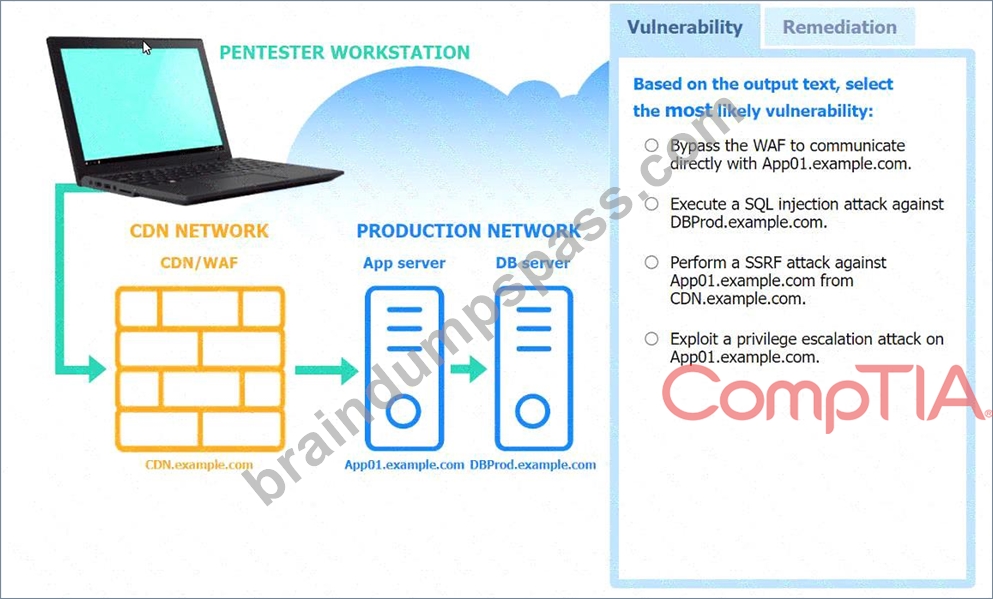
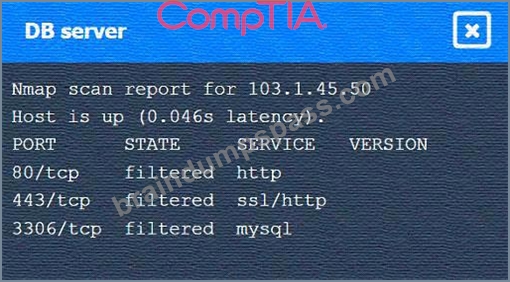
Answer:
Explanation:
See the explanation part for detailed solution.
Explanation:
A screenshot of a computer Description automatically generated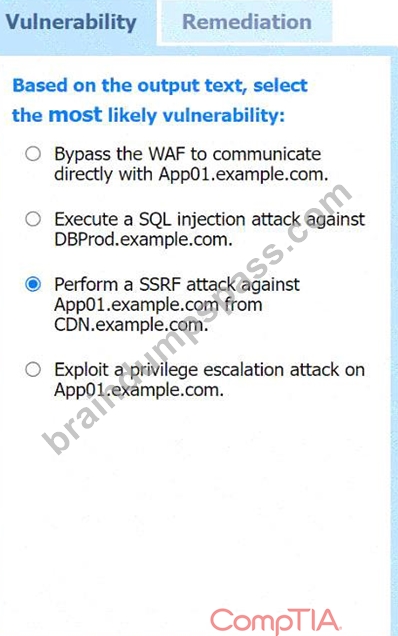
A screenshot of a computer screen Description automatically generated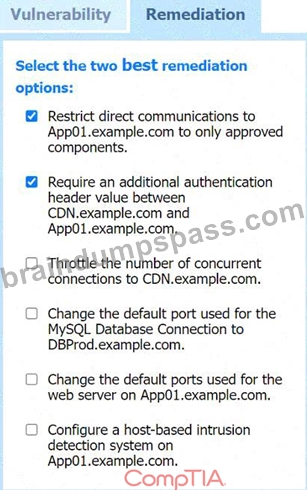
Most likely vulnerability: Perform a SSRF attack against App01.example.com from CDN.example.com.
The scenario suggests that the CDN network (with a WAF) can be used to perform a Server-Side Request Forgery (SSRF) attack. Since the penetration tester has the pentester workstation interacting through the CDN
/WAF and the production network is behind it, the most plausible attack vector is to exploit SSRF to interact with the internal services like App01.example.com.
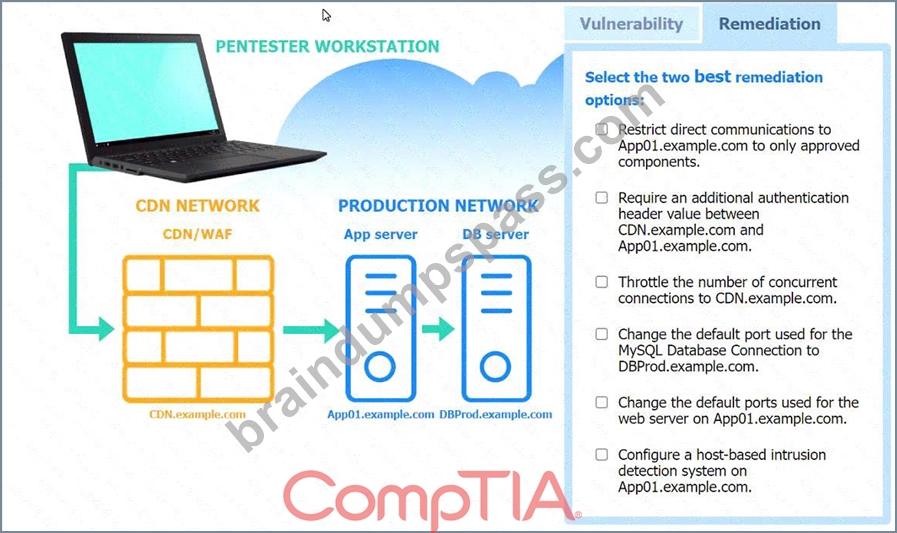
Two best remediation options:
* Restrict direct communications to App01.example.com to only approved components.
* Require an additional authentication header value between CDN.example.com and App01.example.com.
* Restrict direct communications to App01.example.com to only approved components: This limits the exposure of the application server by ensuring that only specified, trusted entities can communicate with it.
* Require an additional authentication header value between CDN.example.com and App01.example.
com: Adding an authentication layer between the CDN and the app server helps ensure that requests are legitimate and originate from trusted sources, mitigating SSRF and other indirect attack vectors.
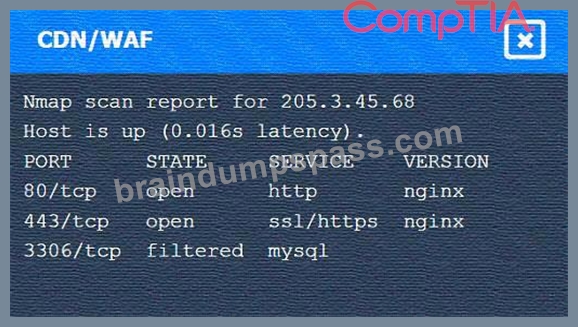
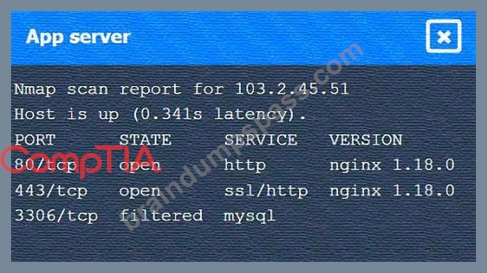
Nmap Scan Observations:
* CDN/WAF shows open ports for HTTP and HTTPS but filtered for MySQL, indicating it acts as a filtering layer.
* App Server has open ports for HTTP, HTTPS, and filtered for MySQL.
* DB Server has all ports filtered, typical for a database server that should not be directly accessible.
These findings align with the SSRF vulnerability and the appropriate remediation steps to enhance the security of internal communications.
NEW QUESTION # 138
A penetration tester downloads a JAR file that is used in an organization ' s production environment. The tester evaluates the contents of the JAR file to identify potentially vulnerable components that can be targeted for exploit. Which of the following describes the tester ' s activities?
- A. SAST
- B. SCA
- C. ICS
- D. SBOM
Answer: B
Explanation:
The tester's activity involves analyzing the contents of a JAR file to identify potentially vulnerable components. This process is known as Software Composition Analysis (SCA). Here's why:
Understanding SCA:
Definition: SCA involves analyzing software to identify third-party and open-source components, checking for known vulnerabilities, and ensuring license compliance.
Purpose: To detect and manage risks associated with third-party software components.
Comparison with Other Terms:
SAST (A): Static Application Security Testing involves analyzing source code for security vulnerabilities without executing the code.
SBOM (B): Software Bill of Materials is a detailed list of all components in a software product, often used in SCA but not the analysis itself.
ICS (C): Industrial Control Systems, not relevant to the context of software analysis.
The tester's activity of examining a JAR file for vulnerable components aligns with SCA, making it the correct answer.
======
NEW QUESTION # 139
A penetration tester captures SMB network traffic and discovers that users are mistyping the name of a fileshare server. This causes the workstations to send out requests attempting to resolve the fileshare server's name. Which of the following is the best way for a penetration tester to exploit this situation?
- A. Reply to the broadcasts with a fake IP address to deny access to the real file server.
- B. Relay the traffic to the real file server and steal documents as they pass through.
- C. Host a malicious file to compromise the workstation.
- D. Respond to the requests with the tester's IP address and steal authentication credentials.
Answer: D
Explanation:
In the scenario where users are mistyping the name of a fileshare server, leading to broadcast requests, the most effective exploitation strategy would be for the penetration tester to respond to these requests with their own IP address (D) and set up a service to capture authentication credentials. This technique is known as a
"Man-in-the-Middle" (MitM) attack, where the attacker intercepts communication between two parties. In this case, the tester can exploit the misdirected requests to potentially capture sensitive information such as usernames and passwords.
NEW QUESTION # 140
A penetration tester is performing an assessment focused on attacking the authentication identity provider hosted within a cloud provider. During the reconnaissance phase, the tester finds that the system is using OpenID Connect with OAuth and has dynamic registration enabled. Which of the following attacks should the tester try first?
- A. A brute-force attack against the authentication system
- B. A replay attack against the authentication flow in the system
- C. A password-spraying attack against the authentication system
- D. A mask attack against the authentication system
Answer: B
Explanation:
OpenID Connect (OIDC) with OAuth allows applications to authenticate users using third-party identity providers (IdPs). If dynamic registration is enabled, attackers can abuse this feature to capture and replay authentication requests.
Replay attack (Option C):
Attackers capture legitimate authentication tokens and reuse them to impersonate users.
OIDC uses JWTs (JSON Web Tokens), which may not expire quickly, making replay attacks highly effective.
Reference:
Incorrect options:
Option A (Password spraying): Effective against user accounts, but this attack targets authentication tokens.
Option B (Brute-force attack): Less effective against OAuth-based authentication since tokens replace passwords.
Option D (Mask attack): Related to password cracking, not OAuth authentication attacks.
NEW QUESTION # 141
Which of the following protocols would a penetration tester most likely utilize to exfiltrate data covertly and evade detection?
- A. HTTPS
- B. DNS
- C. SMTP
- D. FTP
Answer: B
Explanation:
Covert data exfiltration is a crucial aspect of advanced penetration testing. Penetration testers often need to move data out of a network without being detected by the organization's security monitoring tools. Here's a breakdown of the potential methods and why DNS is the preferred choice for covert data exfiltration:
* FTP (File Transfer Protocol) (Option A):
* Characteristics: FTP is a clear-text protocol used to transfer files.
* Drawbacks: It is easily detected by network security tools due to its lack of encryption and distinctive traffic patterns. Most modern networks block or heavily monitor FTP traffic to prevent unauthorized file transfers.
* References: The use of FTP in penetration testing is often limited to environments where encryption is not a concern or for internal transfers where monitoring is lax. It's rarely used for covert exfiltration due to its high detectability.
* HTTPS (Hypertext Transfer Protocol Secure) (Option B):
* Characteristics: HTTPS encrypts data in transit, making it harder to inspect by network monitoring tools.
* Drawbacks: While HTTPS is more secure, large amounts of unusual or unexpected HTTPS traffic can still trigger alerts on sophisticated security systems. Its usage for exfiltration depends on the network's normal traffic patterns and the ability to blend in.
* References: HTTPS is used when there is a need to encrypt data during exfiltration. However, it can still be flagged by traffic analysis tools if the data patterns or destinations are unusual.
* SMTP (Simple Mail Transfer Protocol) (Option C):
* Characteristics: SMTP is used for sending emails.
* Drawbacks: Like FTP, SMTP is not inherently secure and can be monitored. Additionally, large or frequent email attachments can trigger alerts.
* References: SMTP might be used in some exfiltration scenarios but is generally considered risky due to the ease of monitoring email traffic.
* DNS (Domain Name System) (Option D):
* Characteristics: DNS is used to resolve domain names to IP addresses and vice versa.
* Advantages: DNS traffic is ubiquitous and often less scrutinized than other types of traffic. Data can be encoded into DNS queries and responses, making it an effective covert channel for exfiltration.
* References: Many penetration tests and red team engagements leverage DNS tunneling for covert data exfiltration due to its ability to bypass firewalls and intrusion detection systems. This technique involves encoding data within DNS queries to an attacker-controlled domain, effectively evading detection.
Conclusion: DNS tunneling stands out as the most effective method for covert data exfiltration due to its ability to blend in with normal network traffic and avoid detection by conventional security mechanisms.
Penetration testers utilize this method to evade scrutiny while exfiltrating data.
NEW QUESTION # 142
......
If you're still learning from the traditional old ways and silently waiting for the test to come, you should be awake and ready to take the exam in a different way. Study our PT0-003 training materials to write "test data" is the most suitable for your choice, after recent years show that the effect of our PT0-003 Guide Torrent has become a secret weapon of the examinee through qualification examination, a lot of the users of our PT0-003 guide torrent can get unexpected results in the examination. Now, I will briefly introduce some details about our PT0-003 guide torrent for your reference.
Certification PT0-003 Book Torrent: https://www.braindumpspass.com/CompTIA/PT0-003-practice-exam-dumps.html
- Study Anywhere With www.dumpsquestion.com Portable CompTIA PT0-003 PDF Questions Format ???? Go to website ▛ www.dumpsquestion.com ▟ open and search for ▷ PT0-003 ◁ to download for free ????New PT0-003 Test Vce
- PT0-003 valid exam format - PT0-003 free practice pdf - PT0-003 latest study material ???? Download ⏩ PT0-003 ⏪ for free by simply entering 《 www.pdfvce.com 》 website ????New PT0-003 Test Vce
- Reliable PT0-003 Test Labs ???? Positive PT0-003 Feedback ???? PT0-003 Valid Test Book ???? Go to website ⏩ www.verifieddumps.com ⏪ open and search for “ PT0-003 ” to download for free ????New PT0-003 Mock Exam
- Valid PT0-003 Exam Sims ???? PT0-003 Latest Materials ???? Latest PT0-003 Exam Format ???? Immediately open 《 www.pdfvce.com 》 and search for “ PT0-003 ” to obtain a free download ????PT0-003 Valid Test Blueprint
- Study Anywhere With www.vceengine.com Portable CompTIA PT0-003 PDF Questions Format ???? Open ➽ www.vceengine.com ???? enter ➥ PT0-003 ???? and obtain a free download ????Latest PT0-003 Exam Format
- PT0-003 Valid Test Book ???? Latest PT0-003 Exam Format ???? Reliable PT0-003 Test Labs ???? Go to website ⮆ www.pdfvce.com ⮄ open and search for ➤ PT0-003 ⮘ to download for free ????PT0-003 Certification Practice
- PT0-003 Valid Torrent ???? PT0-003 Valid Test Blueprint ⛰ PT0-003 Certification Practice ???? Enter ➥ www.practicevce.com ???? and search for ➽ PT0-003 ???? to download for free ????PT0-003 Exam Simulations
- Pass-Sure New PT0-003 Test Bootcamp, Ensure to pass the PT0-003 Exam ???? Open ▷ www.pdfvce.com ◁ and search for “ PT0-003 ” to download exam materials for free ????PT0-003 Valid Exam Blueprint
- CompTIA - High Hit-Rate PT0-003 - New CompTIA PenTest+ Exam Test Bootcamp ???? Go to website ➽ www.dumpsquestion.com ???? open and search for [ PT0-003 ] to download for free ????Valid PT0-003 Test Blueprint
- PT0-003 Valid Test Book ???? New PT0-003 Mock Exam ???? PT0-003 Valid Exam Blueprint ???? Open 【 www.pdfvce.com 】 enter 【 PT0-003 】 and obtain a free download ▶New PT0-003 Test Vce
- PT0-003 valid exam format - PT0-003 free practice pdf - PT0-003 latest study material ???? Search on 【 www.examcollectionpass.com 】 for “ PT0-003 ” to obtain exam materials for free download ????Valid PT0-003 Exam Sims
- kobihrxi864917.luwebs.com, poppyuszj534248.daneblogger.com, margiehldf528644.onzeblog.com, karimjlpz828086.blogsvila.com, rajanopvf336130.theideasblog.com, social-lyft.com, thebookmarkage.com, www.stes.tyc.edu.tw, marleydqps103974.blog5star.com, haseebdxhq442811.wikidirective.com, Disposable vapes
BONUS!!! Download part of BraindumpsPass PT0-003 dumps for free: https://drive.google.com/open?id=1t5EUW-UHBmJCzbGVCqvAEbA-InNanugq
Report this wiki page